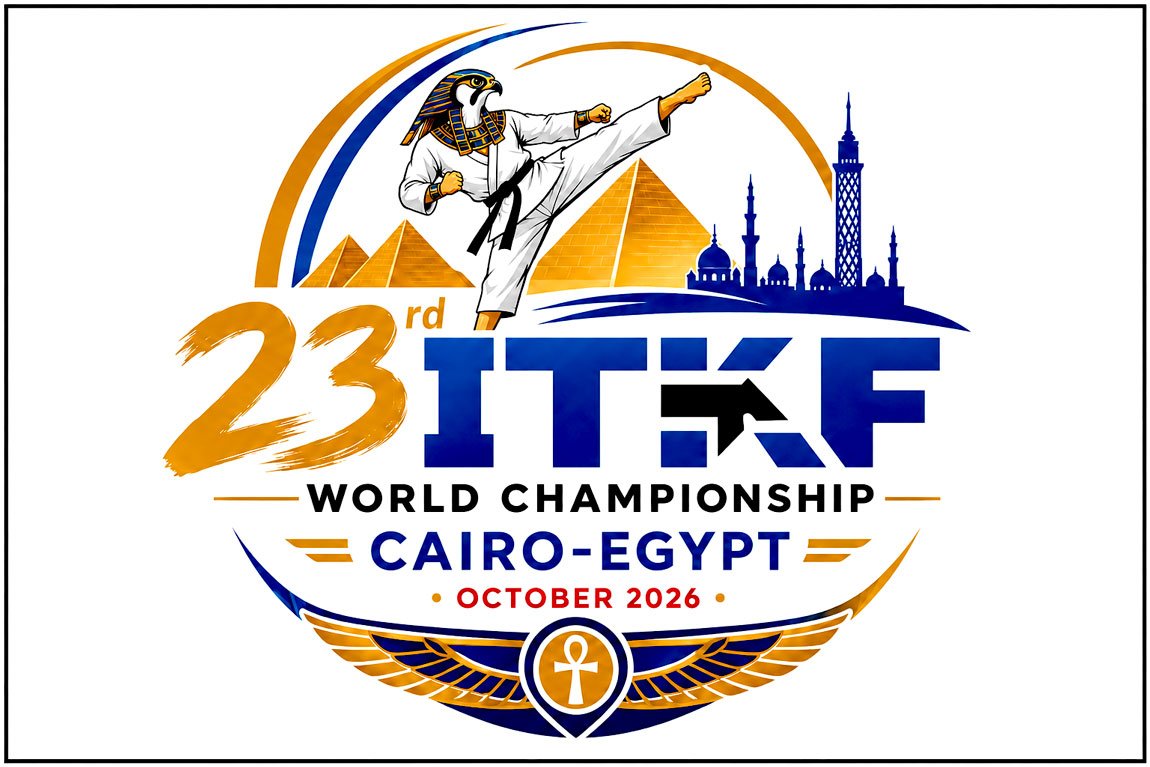
Local Organizing Committee presents the official visual identity of the 23rd Traditional Karate World Championship, bringing together symbols of ancient Egyptian civilization and the timeless values of Traditional Karate in a distinctive and meaningful design.
By Paulo Pinto | Global Sports
Curitiba, Brazil | June 27, 2026
The 23rd Traditional Karate World Championship has officially gained its visual identity. With just over four months remaining before the opening ceremony, the Local Organizing Committee (LOC) unveiled, on Thursday (June 25), the official logo that will represent Cairo 2026 throughout the event’s international communication campaign and symbolize the gathering of athletes and officials from five continents in the Egyptian capital.
More than a graphic symbol, the logo embodies the philosophy behind the World Championship by bringing together Egypt’s millenary heritage and the timeless principles that define Traditional Karate. Rich in symbolism, the composition establishes a dialogue between past, present, and future, combining iconic elements of Egyptian civilization with the spirit of the martial art.
At the heart of the design stands Horus, one of the most important deities of Ancient Egypt, portrayed wearing a karate-gi while performing a high kick. Far beyond an artistic choice, the image transforms one of Egypt’s most recognizable cultural symbols into a visual representation of the discipline, courage, honor, and constant pursuit of excellence that have guided Traditional Karate throughout its history.
The contemporary skyline of Cairo shares the composition with the Pyramids of Giza, creating a visual bridge between one of humanity’s oldest civilizations and the modern city that will welcome the world’s Traditional Karate community. At the base of the artwork, the Ankh—Egypt’s ancient symbol of life—reinforces the logo’s cultural identity, while the circular lines surrounding the composition convey movement, unity, and the gathering of nations around the universal values of Traditional Karate.
When Tradition and Identity Meet
Rather than simply creating an event logo, the Local Organizing Committee sought to develop a visual identity capable of expressing the very essence of the World Championship. Every element was carefully designed to integrate Egypt’s extraordinary historical legacy with the universal principles of Traditional Karate, reinforcing Cairo 2026’s official motto:
According to Local Organizing Committee President Ramy El-Mekkawy, the visual identity was conceived to become a bridge between Egypt’s ancient heritage and the timeless spirit of Traditional Karate.
“One World, One Spirit, Ultimate Honor.”
“Our intention was to create a visual identity that would represent much more than a championship. We wanted to show the world the union between Egypt’s millenary history and the enduring values of Traditional Karate, symbolizing discipline, honor, and respect. This logo is not simply a visual identity—it represents a bridge between Egypt’s ancient heritage and the spirit, discipline, and honor of Traditional Karate,” said El-Mekkawy.
The unveiling of the official logo marks the beginning of a new phase in the World Championship’s international communication strategy, which will now intensify the promotion of the event, its participants, and the preparations to welcome athletes, officials, and guests from dozens of countries.
With its official visual identity now unveiled, Cairo 2026 enters a new phase of international promotion. Over the coming months, the Local Organizing Committee is expected to intensify the dissemination of information about the championship, its participants, and the extensive preparations underway to welcome the world’s Traditional Karate community to the land of the Pharaohs.

ITKF Global Chairman Professor Dr. Gilberto Gaertner emphasizes that Cairo 2026’s visual identity successfully reflects the values of Traditional Karate while strengthening the international profile of the World Championship © Global Sports
A Milestone for ITKF Global
For ITKF Global Chairman Professor Dr. Gilberto Gaertner, the unveiling of the official visual identity represents another important milestone in the preparations for the World Championship and reinforces the organization’s commitment to strengthening the international image of Traditional Karate.
“A visual identity is the world’s first contact with a World Championship. It must communicate not only the culture of the host nation, but also the values that ITKF has preserved since its foundation. Cairo 2026 successfully brings these two elements together, reinforcing the truly international dimension of our discipline,” said Gaertner.
Decoding Cairo 2026’s Visual Identity
HORUS KARATEKA – The central figure merges the Egyptian god Horus with a karate-gi, symbolizing protection, strength, leadership, and the very essence of Traditional Karate.
PYRAMIDS OF GIZA – One of humanity’s greatest cultural landmarks, the pyramids immediately identify Egypt as the host nation of the 23rd Traditional Karate World Championship.
CAIRO SKYLINE – The silhouette of Egypt’s modern capital creates a visual dialogue between the country’s ancient heritage and the contemporary city that will welcome athletes from five continents.
ANKH – The ancient Egyptian symbol of life reinforces the logo’s cultural identity and serves as the foundation of the overall composition.
BLUE AND GOLD – The dominant colors establish a harmonious balance between ITKF’s institutional identity and the tones traditionally associated with Ancient Egyptian art and history.
CIRCULAR STROKES – The sweeping arcs surrounding the artwork evoke movement, unity, and the gathering of nations around the universal values of Traditional Karate.
With its official visual identity now presented to the world, Cairo 2026 becomes more than a date on the ITKF international calendar. It now has a symbol capable of expressing the encounter between one of the world’s oldest civilizations and the timeless values of Traditional Karate. From this moment forward, that identity will accompany every step of the World Championship’s journey until athletes, officials, and delegates from five continents gather in Egypt this October.